Composite Lab
This proposal presents a modular, safe, and future-ready composite life skills lab within a single 600 sq.ft. room. The lab is planned as decided collaboration area and a secure tool crib. The design aligns to CBSE’s Composite Skill Lab expectations (space, modularity, safety, and multi-sector skilling) and maps strongly to ICSE SUPW craft/service outcomes.
- STAR Innovators – CBSE Skill Education Initiative
- CBSE introduced Skill Education in the 1970s to promote practical, career-oriented learning. Today, it is an examinable subject from Classes IX-XII.
- Aligned with NEP 2020, Skill Education is now introduced from Class VI with mandatory implementation for Classes VI-VIII as per NCF-SE 2023.
- STAR Innovators brings this vision to life through hands-on, future-ready learning experiences in schools.
Components
Curriculum
Teacher Training & Staffing
Time Table
Composite Skill Lab (CSL)
Industry Partnership
Description
Provided by CBSE, aligned with NCERT textbooks
Teachers are identified or hired specifically for skill education and trained in pedagogy, curriculum delivery, and practical/technical aspects.
110 hours annually for Skill Education (Classes VI-X)
Multi-Sector, hands-on learning space designed for experiential
Exposure through industry visits and guest expert sessions.
Alignment With NEP 2020 & NCF 2023
- Hands-on exposure to multiple sectors in a single integrated lab space.
- Theory in Action: Bridges classroom knowledge with real-life applications.
- Interdisciplinary Learning: Cross-sector projects (Agri-tech, Sustainable Fashion, Entrepreneurship).
- 21st Century Skill Development: Critical Thinking, communication, collaboration, problem-solving.
- Inclusivity & Accessibility: Equitable participation for all students
- Technology Integration: Use of Videos, Apps and Multimedia tools.
Suitable Room Requirements
- Adequate ventilation (windows + exhaust fans)
- At least two clear walls for pegboards/posters
- Proper electrical setup (15A & 5A sockets, lights, fans)
- Access to water & drainage (based on sectors)
- Preferably near open/garden area for agriculture
Lab Layout & Design
- Modular lab for flexible reconfiguration
- Toolkit-based approach for evolving sector needs
- Easily adaptable for future technologies
Tools, Equipment & Furniture
- Concrete or rubber-mat flooring (avoid vitrified tiles)
- Anti-static mats for electronics zones
- 15A & 5A sockets on all walls with cable management
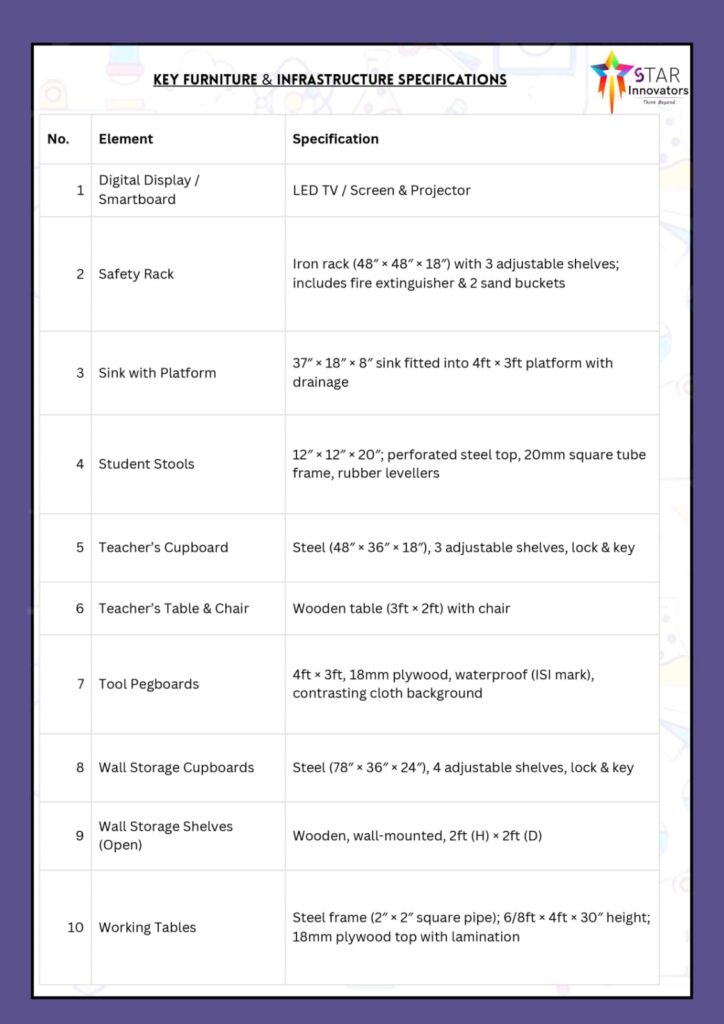
- Working tables: 5ft × 4ft or 6ft × 4ft (wooden tops)
- Storage cupboards: 6.5ft × 3ft × 2ft with labelled shelves
- Pegboards: 4ft × 3ft for tool display
- LED screen / Projector for multimedia learning
Safety Protocols
- Dedicated Safety Corner near entrance with PPE
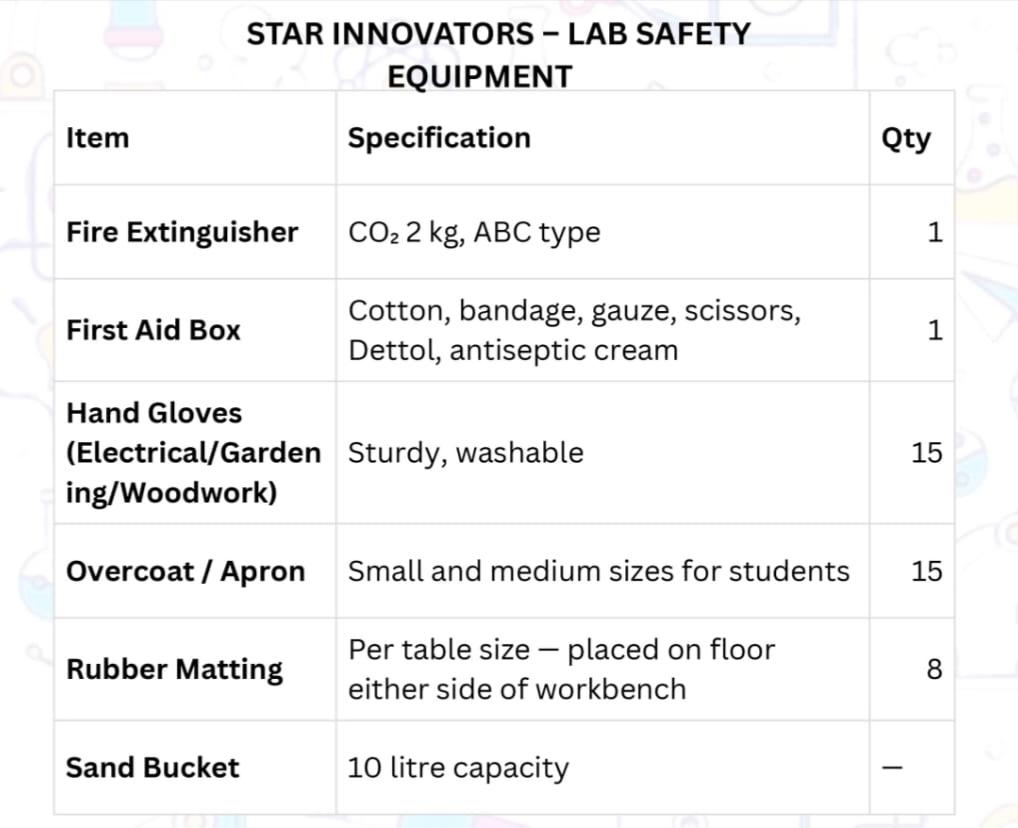
- Fire extinguisher, first aid kit, rubber mats, sand buckets
- Display Do’s & Don’ts posters prominently
- Conduct regular evacuation & fire drills
INTRODUCTION TO MAJOR SECTORS
The Multi-Sector Approach
The Composite Skill Lab reflects the interdisciplinary nature of multiple sectors across the three forms of work.
The multi-sector approach enables students to:
Gain broad exposure across domains
Identify interests and career pathways
Understand connections between different trades
Sector-Wise Descriptions
Agriculture & Gardening — Life Forms
Kitchen gardens, greenhouses, hydroponics, terrace farming, soil sensors, and irrigation systems.
➨ Develops practical biology, ecology knowledge, and agri-entrepreneurship mindset
Food Production — Life Forms
Food processing, preservation, cooking methods, baking, and packaging.
➨ Promotes food safety, reduces waste, and encourages entrepreneurship
Electronics / Mechatronics — Machines & Materials
Mechatronics, electronics, robotics, Industry 4.0, IoT, and smart manufacturing.
➨ Prepares students for automation, AI-driven industries, and advanced engineering
Apparel — Machines & Materials
Fashion design, textile design, block printing, embroidery, sewing, and weaving.
➨ Builds creativity, craftsmanship, cultural appreciation, and entrepreneurship
Automotive — Machines & Materials
Mechanical, electrical, and fabrication skills with focus on EV transition.
➨ Hands-on learning integrating electronics, AI, coding, and mechanics
Carpentry / Woodwork — Machines & Materials
Woodworking connects mathematics (geometry, mensuration) with creative design.
➨ Students build real products, developing problem-solving and entrepreneurial mindset
Healthcare — Human Services
First aid, patient care, pharmaceuticals, preventive healthcare, diagnostics, and AYUSH systems.
➨ Develops empathy, precision, teamwork, and prepares students for allied health careers
Retail — Human Services
Inventory management, logistics, merchandising, customer service, and e-commerce.
➨ Builds marketing knowledge, communication skills, and entrepreneurial mindset
Safety Guidelines for Composite Skill Lab (CSL)
Ensuring a safe, secure, and conducive learning environment is essential in a Composite Skill Lab, where students interact with diverse tools, machines, and materials.
General Safety Guidelines
Infrastructure & Emergency Preparedness
Provide minimum two wide exit doors for safe and quick evacuation
Install adequate fire extinguishers at accessible locations
Ensure clear emergency pathways and signage
Conduct regular fire drills and evacuation training
Equipment & Maintenance Safety
Perform periodic inspection of electrical fittings and insulation
Ensure all gas fittings comply with prescribed safety standards
Identify and rectify vulnerable points to prevent accidents
Maintain tools and machines in proper working condition
Operational Safety Practices
Provide regular training on safe handling of tools and equipment
Display Do’s and Don’ts prominently across the lab
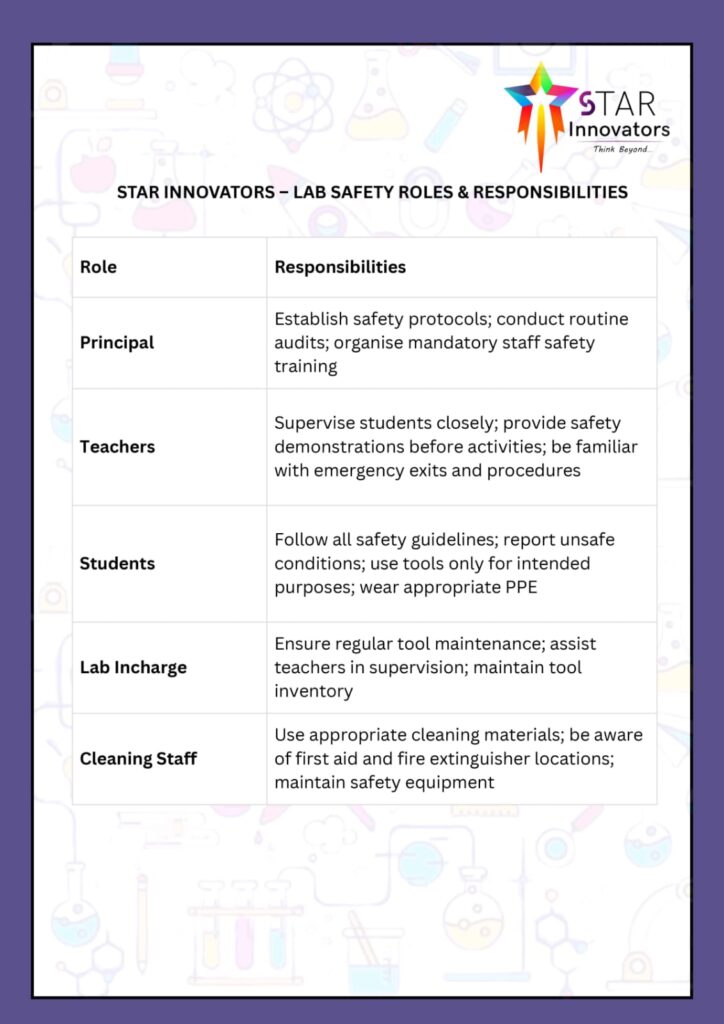
Ensure strict supervision by teachers/lab in-charge during all sessions
Encourage disciplined and responsible behavior among students
Personal Safety Measures
Ensure mandatory use of PPE (Personal Protective Equipment)
(gloves, goggles, aprons, etc.)
Maintain safe posture and workspace organization
Promote awareness of hazards and risk prevention
Storage & Emergency Readiness
Store all tools and materials in a safe, labelled, and organized manner
Keep a fully stocked First Aid Kit easily accessible at all times
Train students in basic first aid and emergency response procedures
Compliance & Continuous Monitoring
Conduct regular safety audits and inspections
Update safety protocols based on latest standards and requirements
Reinforce safety practices through continuous awareness programs
Safety Corner & Drills
Position the safety rack near the lab entrance for quick access during emergencies
Include all relevant PPE, fire extinguisher, and first aid kit
Add sector-specific safety gear based on chosen skill subjects
Display safety instruction posters using bright colours at prominent locations
Conduct regular safety drills and ensure all students know emergency procedures
Safety Provisions Embedded At Installation
Anti-slip textured flooring in water-prone areas; anti-static mats for electronics
Under-desk cable trays; surge protectors and UPS for all workstations
Tool-specific hazard warning labels; heat-resistant surfaces for irons and steamers
Easily accessible emergency stop buttons on all machines
Lockable, ventilated chemical storage for fertilisers and pesticides
Needle/sharps disposal containers; handwashing stations with antibacterial soap
Shaded garden work areas and proper ventilation to prevent heat exhaustion
Integrating Artificial Intelligence
Artificial Intelligence has become an integral part of the workforce. According to the World Economic Forum
Future of Jobs Report 2025, 86% of employers expect AI and information processing technologies to transform
their business by 2030. Big Data, AI, and FinTech lead the list of the top 10 fastest-growing jobs. Students must be prepared.
Objectives of AI Infrastructure in the CSL
Hands-on Experiential Learning — Training on industry-aligned practical AI skills to enhance employability
AI for Social Good — Students develop AI-enabled solutions for real-world challenges across all three forms of work
Entrepreneurial Mindset — Access to AI tools to explore technology-integrated business models and self-employment options